Virtual Brain
Vr Eye Movement Cognitive Assessment and Rehabilitation Training System
VREye movement cognitive assessment system, VR cognitive motor dual rehabilitation training system, VR virtual scene customization
Vr Eye Movement Cognitive Assessment and Rehabilitation Training System
VREye movement cognitive assessment system, VR cognitive motor dual rehabilitation training system, VR virtual scene customization

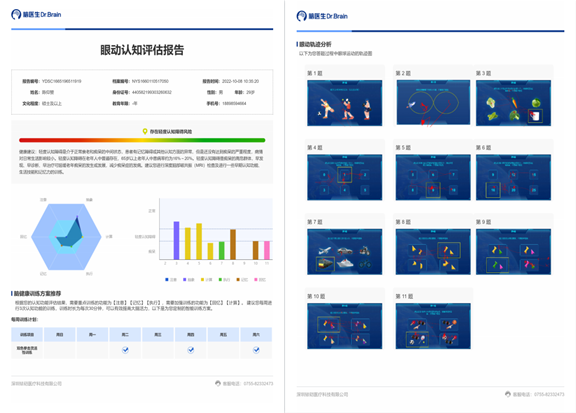
Based on the characteristics of cognitive disorders and the use of VR technology, an immersive task testing environment is constructed for participants. Through eye tracking technology, the eye movement trajectories of participants during task execution are recorded and analyzed in real-time, and their cognitive abilities such as attention, abstraction, memory, computation, and executive recall are evaluated, which can accurately distinguish between normal and abnormal situations; Mild cognitive impairment; Dementia population, as well as predicting their short cognitive assessment scales MMSE, MoCA scores, and AI automatic matching of cognitive rehabilitation training plans.
Report
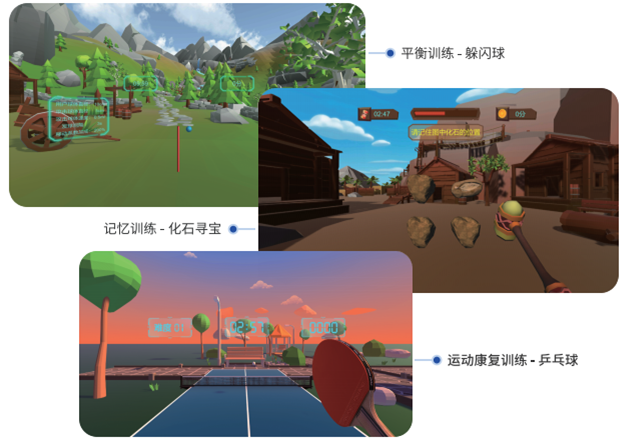
The Chinese Guidelines for Cognitive Training (2022 edition) point out that new cognitive training methods based on VR and other approaches are very effective for cognitive rehabilitation. VR technology provides patients with an immersive training environment that can simulate real-world scenarios and tasks. This helps to increase patient engagement and motivation, thereby improving training effectiveness. Equipped with various cognitive rehabilitation training tasks, such as fossil hunting, boxing, catching fireflies, supermarket shopping, etc., it can provide rehabilitation training for abilities such as attention, abstraction, memory, calculation, execution, and recall. At the same time, there are various sports rehabilitation training tasks built-in, such as dodge ball, table tennis, etc., which can provide rehabilitation training for balance ability, limb control ability, coordination ability, visual spatial sense, etc.
Customizing diversified virtual scenes using virtual reality technology can be widely used in education, rehabilitation treatment, pain management, remote medicine, and other fields.
Product
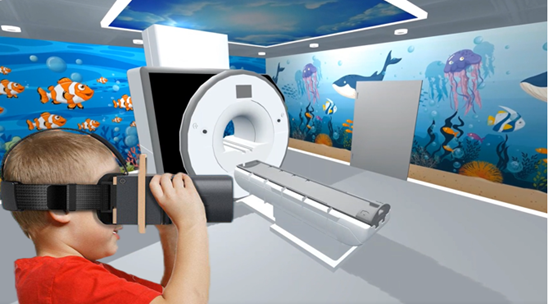
Children, people with mild claustrophobia, and those undergoing first-time magnetic resonance imaging (MRI) examinations should undergo adaptive training using VR in advance to reduce anxiety, reduce the frequency of sedation and anesthesia, and improve the success rate of MRI scans.